Self-Custody Is Not Just a "Vibe"
The CLARITY Act is turning a crypto slogan into a legal boundary.
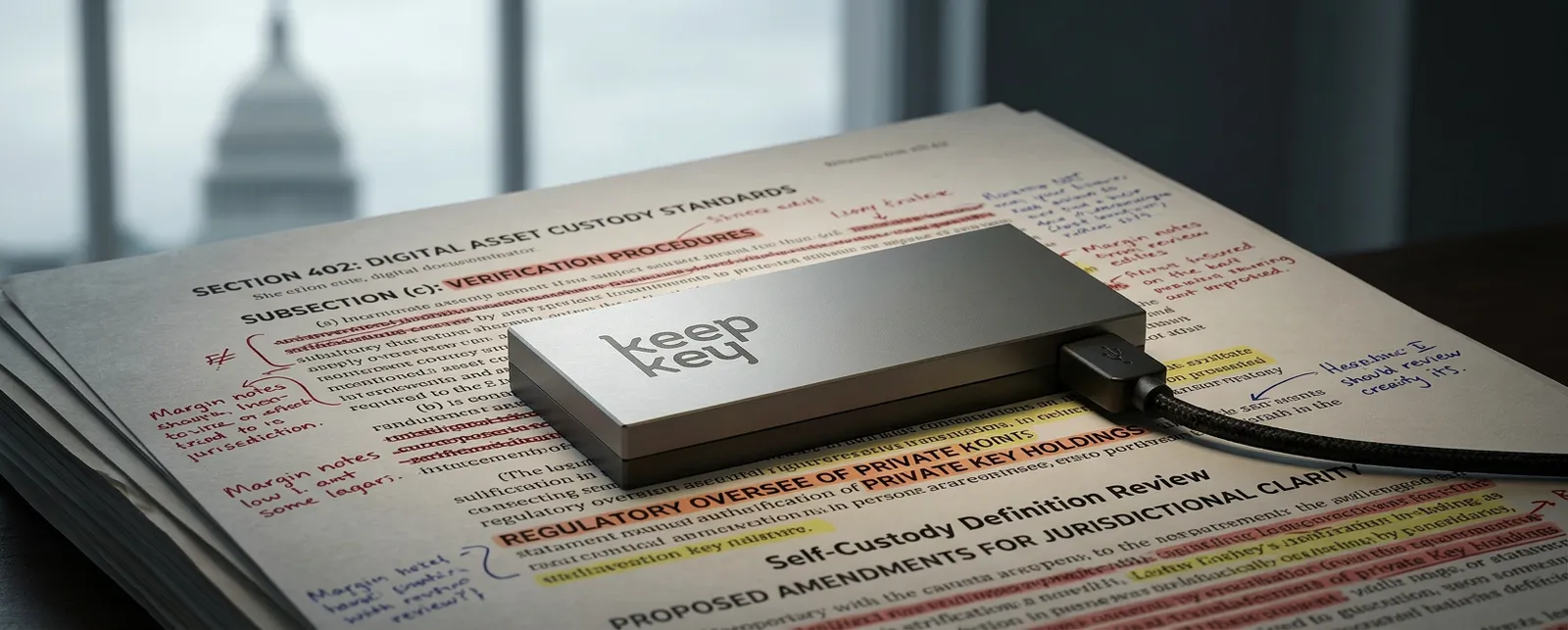
Everyone markets self-custody as an aesthetic and jumps at the chance to plaster copy across socials with a hot buzzword. Now Congress is trying to turn self-custody into an actual legal boundary, and it is worth asking who benefits when that boundary gets written into law.
That translation matters.
Once Congress defines the boundary, "self-custody" stops being just a personal habit. It becomes a legal category.
The CLARITY Act passed the House and has advanced out of the Senate Banking Committee. With a tight window before elections, it may still reach the floor for a vote and it's worth looking at what the regulators are considering.
The self-custody language largely protects lawful self-custody, but explicitly preserves enforcement for AML, sanctions, illicit finance, terrorism financing, and related laws.
Where the battle really lies is the next layer: altcoins, exchanges, DeFi, stablecoins, token issuance, market intermediaries, and the SEC/CFTC boundary.
Proponents of the bill include major crypto companies and industry groups backed by a pro-crypto PAC network that has amassed nearly $200 million. They are interested in regulation that doesn't just define their products, but protects them. It is not all about influencing one bill, but the way the industry will be regulated as a whole.
The CLARITY Act would move the industry closer to that goal.
Detractors rightfully point out that the CFTC has less consumer protection and regulatory power than the SEC, and handing over a large portion of the oversight of these products would likely weaken any protections there are now. Anyone really paying attention, though, knows the SEC's current approach has not exactly produced a clean or reliable consumer-protection regime either. The real win for the big money exchanges and DeFi is a legal framework that is defined enough for them to invest in real infrastructure and strong enough to know that it won't change with the slightest breeze.
Look at the history of legislation around crypto for a little while and you see the same pattern.
- The industry has ideas and money, and they want regulators to weigh in.
- Bad actors take advantage of loopholes and entire sectors get captured by wholly unethical orgs or personality cults just waiting for the hammer to drop.
Here's where the gap is finally closed. Self-custody would be defined the way the community already uses it, and enshrined in law as a starting point. Scams and funnels will keep getting built on top of that, but the real success — the thing good-faith actors can actually invest and build around — is the legal definition itself.
It's useful. If it passes, maybe we really can put on some noggles and summer-vibe about self-custody for a minute. It would be a win. But the work to protect that hard-fought right comes next, because a massive pile of bad actors will come straight for it with backdoors disguised as software-as-a-service, social engineering, phishing schemes, and whatever else they can dress up as convenience.
Trust Ledger claims · sources · uncertainty
Claims checked
- The CLARITY Act passed the House and advanced out of the Senate Banking Committee (status as of writing).
- Pro-crypto PAC network approaching $200 million in committed funds.
- The bill's self-custody language preserves AML, sanctions, and illicit-finance enforcement.
Primary sources
- H.R. 3633, Digital Asset Market Clarity Act — Congress.gov legislative record.
- Axios — the Fairshake pro-crypto PAC network's ~$200M war chest (January 2026).
Commercial interests
- The author's employer is a self-custody vendor and would benefit from a favorable statutory definition of self-custody.
What is confirmed / what remains uncertain
- Confirmed: the bill's House passage and committee progress; the broad SEC/CFTC jurisdiction restructuring it proposes.
- Uncertain: whether the bill reaches a Senate floor vote before elections; final text of the self-custody provisions. This is analysis and opinion about pending legislation, not legal advice.